
For a long time, affiliate marketing seemed to be a niche of intense competition, with the same GEOs, offers, and traffic, where everyone was constantly fighting for results. However, the market isn’t driven solely by numbers and volumes, but also by people. Affiliates communicate, share insights, and sometimes directly influence each other’s deals. In the new edition of Point of View, we spoke with Sergey Zakharenko, Lead BizDev at Already Media, and Max, Head of Affiliates at Moon Partners, about finding the balance between collaboration and competition and why it’s almost impossible to grow in affiliate marketing without a strong network.
Connections That Drive Revenue
In what situations do competitors become partners?
Honestly, the idea that everyone in affiliate marketing is your enemy is outdated. I’ve seen many cases where competitors help each other by introducing partners to advertisers, sharing offers that they can’t scale themselves, reselling traffic, and brokering deals. In the end, they often make more money than if they were trying to compete head-on. – Sergey Zakharenko, Lead BizDev at Already Media
Historically, competitors in the affiliate industry were seen as a threat — as people who would take your traffic, partners, or even your team. This mindset is based on the idea that the market is limited and that everyone is fighting over the same resources. However, if you consider how the market is evolving today, this logic no longer fully applies. The affiliate has grown. New GEOs and approaches have emerged, making it clear that the market is large enough for both competition and coexistence. At Moon Partners, we increasingly view competitors as comrades because, in reality, we’re all solving similar challenges. In that context, competitors don’t become “friends” in the traditional sense, but they definitely move closer to becoming partners. Today you compete, and tomorrow you might be working together. – Max, Head of Affiliates at Moon Partners
How much does networking actually impact results in affiliate marketing?
Networking is one of the key assets in affiliate marketing. In our industry, it’s not just about budgets, teams, or technology. It’s about the people around you. Through them, you can gain access to closed offers, higher rates, faster approvals, and insights that are rarely shared publicly. And what is most important is speed. The market is overheated right now, so the winners aren’t the ones with the most resources, but rather, the ones who know how to use their resources efficiently and adapt quickly. If you have a strong network, you’re already one or two steps ahead. – Sergey Zakharenko, Lead BizDev at Already Media.
Affiliate marketing itself is based on partnerships, so networking is an essential part of this model. In this industry, success isn’t just about driving traffic. It’s also about communicating effectively and building strong relationships. A strong network opens doors, accelerates connections, and saves time on testing. In many ways, it’s a part of building your personal and business brand. The more people know you and understand how you work, the easier it becomes to scale and enter new GEOs and projects. After all, it’s often not the most technically savvy person who wins, but the most plugged-in one. – Max, Head of Affiliates at Moon Partners.
How can connecting with a competitor benefit your business?
Collaboration only works when there’s mutual benefit. For example, you can:
- Transfer or sell opportunities that you don’t have the resources to handle;
- Share exclusive knowledge about a specific market;
- Exchange experience working with certain operators, such as how reliable they are, how they handle agreements, and how flexible they are.
Of course, no one shares the core of their business. But this level of interaction helps both sides save time and reduce the cost of mistakes. It’s not about friendship – it’s a pragmatic exchange of value. – Sergey Zakharenko, Lead BizDev at Already Media
It all starts with how you perceive your competitors. As long as you see them only as a threat, that connection has no value. However, once you recognize they can strengthen your position, the opportunity for collaboration arises. This is one of the most effective models today. Competitors are even teaming up. They’re creating content together, appearing on social media together, and sharing audiences. For instance, teams in similar GEOs might publish a joint article or conduct a joint interview, each bringing their own audience. As a result, both sides gain access to new contacts who are already warmed up, which is far more effective than starting those conversations from scratch. A relationship with a competitor starts working for your business the moment you shift from conflict to shared value. – Max, Head of Affiliates at Moon Partners.
Share Or Keep Silent?
What is the best way to build connections with other affiliates?
In my opinion, conferences and face-to-face interaction are the best options. Personal connections are always stronger than cold outreach. You immediately understand who you’re dealing with, such as their level and mindset. However, it’s important to remember that a conference is just the beginning of a conversation. Real relationships are built afterward through joint work, testing, and following through on agreements. Networking truly begins when you’ve made money together. – Sergey Zakharenko, Lead BizDev at Already Media
If we’re choosing from a list, conferences are the strongest starting point because they provide fast access to a large number of contacts and help you enter the community. In reality, though, it’s not about where you meet but how you build those relationships. You can attend dozens of events and remain just another name in someone’s contact list. Or, you can turn a few connections into strong partnerships. If you see real potential in someone, invest in that relationship. Show interest, remember details, personalize your communication, and dedicate extra time. That extra effort creates real value. So it’s not about where you build connections. It’s about how deeply you invest in them. – Max, Head of Affiliates at Moon Partners.
How safe is it to share experiences within the industry?
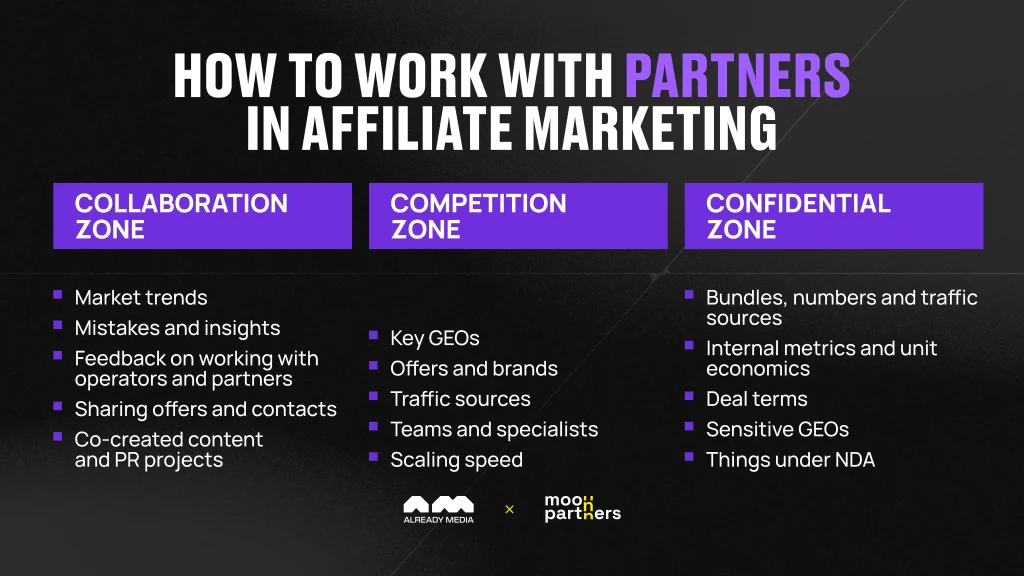
Sharing information and experience is essential. You just need to understand what can be shared externally and what should stay internal. There’s a ‘safe layer’ of information: trends, approaches, hypotheses, and mistakes. Everyone shares this information, which helps the market evolve faster. There are also sensitive areas, such as bundles, sources, numbers, and internal economics. Those should stay within the business. The real issue is that many companies are too closed. As a result, they operate in isolation and eventually fall behind the market. – Sergey Zakharenko, Lead BizDev at Already Media.
It all depends on what you’re sharing. If it’s internal insights that directly drive business results, those should stay within the company, often not just as a strategic decision, but also due to NDAs. But there’s another layer: expert opinions, approaches, and market observations. If this information won’t harm your business but could benefit others, there’s nothing wrong with sharing it. In fact, sharing it builds trust and strengthens your brand in the market. The logic is simple: anything that provides a direct competitive advantage stays inside, while anything that creates value without risk can be shared. – Max, Head of Affiliates of Moon Partners.
Where is the line between what can and cannot be discussed?
The line is quite simple. You can’t disclose brands, deal details, sensitive markets, or traffic sources without permission. However, discussing the market by sharing experiences, approaches, and trends is not only safe, it’s necessary. Openness also builds reputation. If you stay silent, the market won’t notice you. But if you share insights wisely, people start to see you as an expert. – Sergey Zakharenko, Lead BizDev at Already Media.
In most cases, the boundary is clear. NDAs and internal agreements define what is confidential, and that’s nonnegotiable. Every team generally understands what cannot be shared. Anything related to deal terms, partners, internal data, or working setups stays inside. Everything else, including approaches and experience, can be discussed. If there is even slight doubt that the information could impact the business or violate agreements, it is better to keep it internal. – Max, Head of Affiliates at Moon Partners.
The Market Remembers Everything
How important is personal reputation in affiliate marketing?
I’d say it’s critical. The market isn’t as big as it seems. Everyone knows everything about everyone. One delayed payment or an unjustified cut in reconciliation, and word spreads fast. Even if it seems minor, it isn’t. These cases travel quickly across the market. Partners discuss them, and next time, they’ll think twice before working with you. – Sergey Zakharenko, Lead BizDev at Already Media.
Reputation in affiliate is the core currency. The industry is built on relationships, and relationships are built on trust. That trust depends on whether people believe you and whether you follow through on agreements. In many cases, deals rely not on contracts, but on trust. If your word carries weight, entirely different opportunities open up. Reputation is a long-term asset that is difficult to build and easy to lose. In many ways, it’s your real capital in the market. – Max, Head of Affiliates of Moon Partners.
What matters more: deal terms or relationships?
Short-term – terms. Long-term – relationships. You can win once with a tough deal. However, if you damage the relationship or push a partner too hard, you’ll likely lose in the long run. Because in affiliate, the best offers, conditions, and money come through trust. The key is balancing short-term gain with consistent growth. – Sergey Zakharenko, Lead BizDev at Already Media.
In the long run, relationships matter more. Terms can always be renegotiated, but access to those terms comes through trust. When you have strong relationships, you can negotiate better conditions, resolve issues faster, and unlock more opportunities. Relationships give you flexibility across everything else. – Max, Head of Affiliates at Moon Partners.
What’s the formula for healthy competition?
For me, it’s simple. Don’t block others from making money, avoid shady practices, and play the long game. Yes, the industry still faces scams, delayed payments, and gray schemes. Everyone has a choice: work with anyone, or be selective about who you collaborate with. I believe it’s important to talk about these things. Because if you stay silent, you’re essentially accepting the rules. Finally, it’s not the most cunning who wins, but rather, the most reliable and consistent players. – Sergey Zakharenko, Lead BizDev at Already Media.
The formula is straightforward. First, understand that everyone operates in the same market and will inevitably cross paths. Second, maintain basic respect for competitors as professionals and businesses. When you see competitors as peers rather than enemies, toxicity disappears and healthy competition emerges. Competition becomes about achieving results while preserving respect – and the potential to collaborate in the future. – Max, Head of Affiliates at Moon Partners.
Conclusion
Today, the line between “us” and “them” in affiliate marketing is blurred. The people you competed with yesterday could be your partners tomorrow. The real question is no longer about your relationship, but rather, whether you can work together effectively. That’s why balance matters. Too much openness creates risk, while isolation and closed-off behavior often slows growth. Those who win are the ones who know how to build relationships, adapt quickly, and recognize opportunities where others see threats.