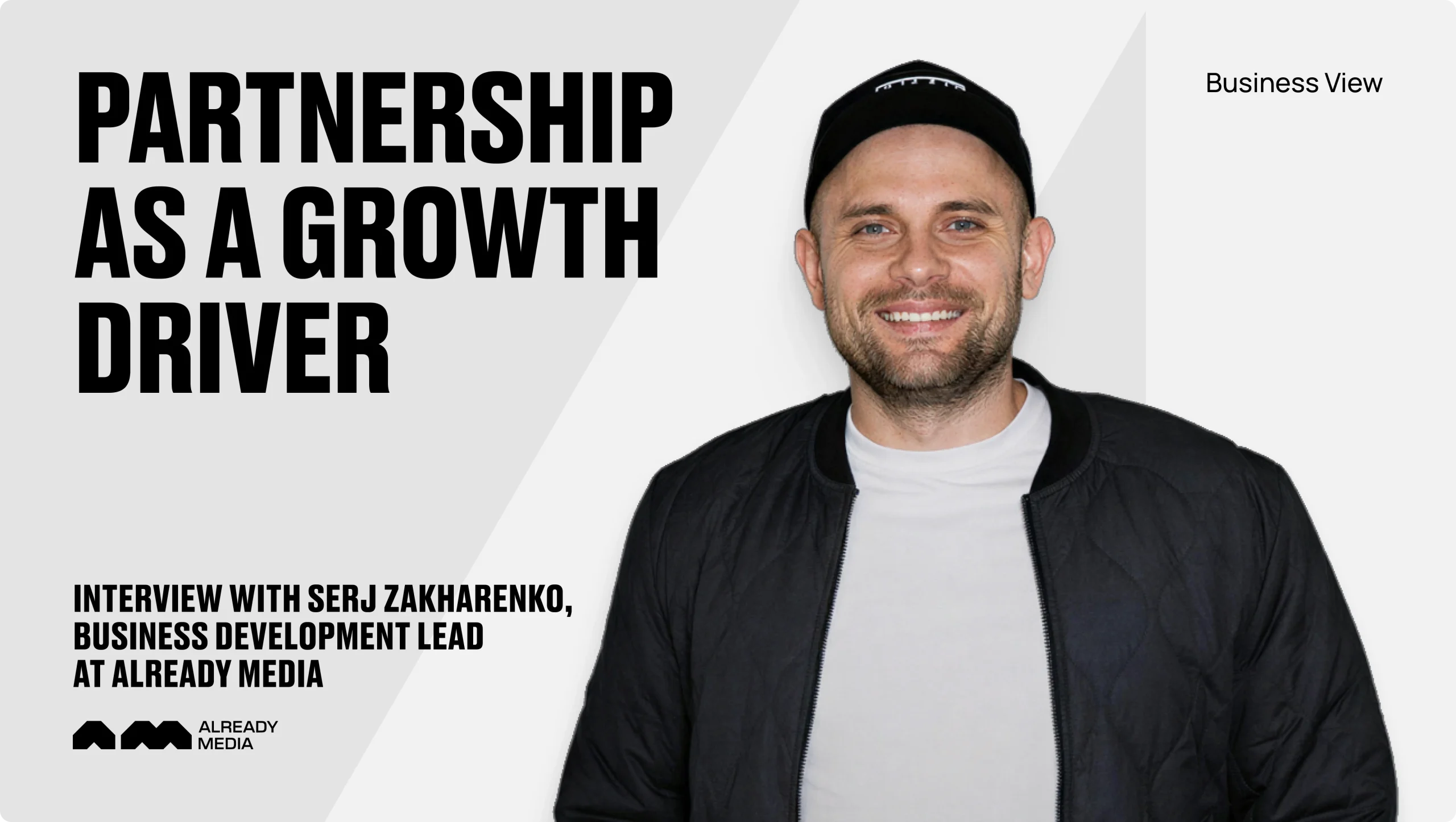
The era of simply driving traffic and expecting instant results is over. Regulators are stricter. Brands are more demanding. Players are far more selective. So, how can you build partnerships in this new reality? What defines affiliate effectiveness today? And why does quality matter more than volume now? In the first edition of our new Business View column, Sergey Zakharenko — Lead BizDev at Already Media — talks about how the company is changing its approach to partner relationships.
Expert background
Sergey, could you tell us a little about your experience in iGaming?
I’ve been in this industry for about 12 years and have seen nearly every stage of the market’s evolution – from its early formation to today’s mature ecosystem. The years 2014–2015 were especially significant. That’s when structured affiliate models began to emerge and new markets started to grow rapidly. Back in 2014, very few people knew how to work with international traffic – traditional affiliate programmes weren’t widespread, so many relied on CPM deals. Gradually, CPA and hybrid models emerged, making the market more structured and predictable.
Over the years, I’ve worked with multiple GEOs, deal formats, and monetization models. This experience enables me to view the industry from both the affiliate and the brand’s perspective, understanding the logic, risks, and expectations of each.
What role do you play in developing the Already Media brand today, and how do you support our partners?
As the BizDev Lead at Already Media, my primary responsibility is to identify and develop non-standard business opportunities. We don’t just launch traffic. We focus on scaling through the right commercial terms, transparent communication, and flexible negotiation. This involves attracting advertisers who aren’t easily found “on the surface” and structuring partnerships across CPA, Hybrid, and RevShare models. At the same time, I expand our partner pool in priority GEOs and build long-term, sustainable relationships.
Can you share three interesting facts about yourself?
- I ran a 64-kilometer ultramarathon in the mountains because I like testing my limits.
- I summited Lenin Peak (23,401 ft), one of the toughest challenges of my life.
- I’ve visited more than 30 countries. Travel broadens your perspective and helps you better understand people and markets.
Affiliate Marketing as Part of Product Strategy
What market changes have affected brand–affiliate collaboration the most?
I would highlight three key factors:
- Rising competition in paid auctions. The number of buying teams has grown significantly. In most GEOs, dozens of teams compete within the same traffic sources. As a result, acquisition costs increase, margins shrink, and winning setups have shorter lifespans. That makes the market overheated.
- Growth of White Label ecosystems. Many sub-brands built on platforms like Soft2Bet, Extendly, and others quickly enter the market and aggressively purchase traffic. This reduces the quality of traffic and the number of stable, long-term partnerships.
- Regulation and AI. Regulatory pressure has intensified. At the same time, AI has lowered the barriers to entry into the industry. This increased competition, but it also impacted the average quality of traffic.
In simple terms, the focus has shifted from volume to quality and sustainability.
What constitutes a mutually beneficial partnership today?
The cost of traffic is higher, and its quality is frequently lower. That’s why long-term partnerships based on LTV calculations and flexible deal structures are more successful in the long run. Nowadays, partnerships are based on economics, transparency, and shared responsibility for results.
How have our partners’ expectations changed, and how should we be working in 2026?
Brands now expect ROAS within 1-2 months. This has dramatically raised the bar for traffic quality and KPI performance. Rising acquisition costs mean that no one is willing to operate at a loss for long. There’s also less patience for long LTV cycles, with more focus on retention and ARPU. Conditions are quickly reviewed if metrics decline. Brands no longer prioritize pure volume. They focus on sustainable performance in key GEOs.
For affiliates, this means adopting a product-driven approach, which includes understanding the audience, improving content quality, and influencing player behavior, rather than just delivering FTDs. To succeed in 2026, you must calculate unit economics before launching campaigns and attract quality players, not just registrations. Flexibility in deal models – Hybrid, KPI bonuses, agency, or spend-based – is essential.
The market is tougher now. Those who think like strategic partners, not traffic suppliers, will win.
Transparency as the Foundation of Trust
Which metrics truly reflect partnership effectiveness?
Focusing only on FTD volume is no longer sufficient. Real value lies in player economics:
- ROAS within a 2-3 month window;
- Retention (D15 / D30 / D60 / D90);
- ARPU and average deposit size;
- Repeat deposits and activity frequency;
- CPA vs. actual LTV ratio;
- Chargeback and fraud rate.
The strongest projects focus on player quality, not just quantity.
What is often missing in communication between brands and affiliates?
First and foremost, communication itself. Some partners still communicate only via email, respond weeks later, or fail to provide feedback entirely. Even obtaining a tracking link can turn into a quest, not to mention contract negotiations. Another issue is misalignment of expectations. If KPIs, allowed sources, payback timelines, and scaling strategies aren’t clearly aligned, conflicts arise.
Now, let’s discuss flexible interaction. In which areas is it important to collaborate closely with brands, and in which areas should affiliates act independently?
Today’s market is fast-paced and expensive. The best approach is to have a strategic plan and to be independent in day-to-day operations. Close cooperation is essential when it comes to goals and economics:
- Aligning KPIs and payback timelines;
- Defining traffic quality requirements;
- Agreeing on scaling plans;
- Revising terms when performance metrics shift.
At the same time, autonomy is critical in creative development and testing, selecting setups and traffic sources, and making fast buying decisions. As a result, both sides move toward shared goals while maintaining speed and independence within their respective areas of responsibility.
What red flags in affiliate behavior signal it’s time to end a partnership?
The core criteria remain the same: trust, transparency, and economics. However, the following behaviors should raise concerns:
- Fraud or the use of gray-hat schemes;
- Violating limits or compliance requirements;
- Manipulating data or attempting to “adjust” traffic reporting;
- Ignoring feedback from the brand;
- Repeatedly breaching agreed-upon terms regarding traffic sources, KPIs, or other conditions.
Importance of Expertise
Why are partnerships now based on content and expertise instead of CPA alone?
Because “buying traffic” has become too expensive and unstable. CPA can generate quick results, but only in the short term. Expertise, on the other hand, scales far better than exclusive commercial terms. It can be adapted across different GEOs, formats, and funnel stages. In this model, content becomes an asset. It builds trust over time and strengthens the overall economics of a project. A pure CPA setup may temporarily increase earnings, but it doesn’t build a sustainable business.
One of the key advantages of partnering with Already Media is our deep understanding of the product and audience. We work across the entire funnel, from warming up traffic and building trust to retention. In this environment, a brand can be built around the value it delivers, not just a promotional offer.
How do joint projects strengthen both sides?
Collaborations, whether case studies, research, special projects, or co-created content, go deeper than standard traffic buying. A brand gains more than just placement. It gains an authoritative communication channel. Through the partner’s expertise, additional trust is formed with the audience, and product integration feels native, not like another ad that players instinctively skip.
Affiliates also benefit. They gain access to unique content and data that strengthen their market position. This is especially valuable in overheated GEOs where competition is intense.
What’s better in the long term: exclusive terms or shared user value?
In the long run, shared user value always wins. When the content and product genuinely solve the player’s needs, everyone benefits: retention grows, LTV increases, and the partnership becomes sustainable. Exclusive terms are a strong accelerator, but not a foundation. They are typically the result of long-term collaboration based on transparency and proven performance.
In my view, the starting point should always be stable economics, clear metrics, and mutual trust. Only after establishing these fundamentals should you consider increasing rates, raising caps, or revising KPIs.
Perspectives and forecasts
How will affiliate partnership models transform over the next 2–3 years?
I expect to see significant market consolidation. The “push traffic, collect CPA” model is gradually fading. In my view, up to 70-80% of affiliates operating solely under this logic may struggle to compete. Those who remain will be those who understand unit economics, work closely with LTV, analyze player behavior, and build long-term relationships.
Which partnership formats will emerge, and which should be left behind?
I see the future in more mature partnership models:
- Hybrid and performance-based models tied to ROAS and clear KPIs;
- Joint analytics and data-sharing, where both sides work transparently with numbers;
- Product-level integrations, where affiliates engage more deeply with the product and meaningfully influence player behavior.
What should already be left behind are short-term CPA strategies without LTV understanding. The “push traffic, hit the cap, and move on” approach is becoming less reality-based. The same applies to source substitution, incentivized traffic schemes, and attempts to inflate volume.
What should brands and affiliates start doing today to stay profitable tomorrow?
Affiliates are gradually becoming part of the brand ecosystem. They are no longer just traffic sources. They are also full-fledged media channels, insight partners within specific geographic regions (GEOs), and influencers of audience quality. This requires building transparent communication, aligning goals and payback timelines, and investing in expertise and brand development.
Conclusion
Today, the industry is shifting toward a balance of genuine human relationships and structured, data-driven work. Numbers alone do not create trust. And agreements without transparent economics cannot deliver sustainable growth for either side – brands or affiliates. At Already Media, we strive to build strong partnerships based on open dialogue, shared goals, and results confirmed by clear metrics.